Table of Contents
ToggleYou’ve decided to take the plunge and grab a Nintendo Switch. You’ve got your cart open, your payment info ready, and then the question hits: does this thing come with any games, or am I staring at a $300 paperweight until I drop another $60?
It’s a fair question. Unlike consoles from past generations that sometimes bundled flagship titles, Nintendo’s approach has evolved. The short answer? Standard Switch packages don’t include physical games, but the full picture has more layers than that. Special bundles, pre-installed software, free-to-play options, and promotional deals can change what you’re actually getting. And with three different Switch models on shelves in 2026, what’s in the box varies more than you might expect.
This guide breaks down exactly what comes with each Switch model, which bundles actually include games, and how to maximize value from day one without blowing your budget on a library you haven’t even started yet.
Key Takeaways
- Standard Nintendo Switch packages don’t include physical games, but special edition bundles like Mario Kart 8 Deluxe offer free-to-play alternatives and download codes at competitive prices.
- New Switch owners can immediately access high-quality free-to-play games like Fortnite, Apex Legends, and Warframe without spending extra money beyond the console purchase.
- Nintendo Switch Online subscription trials provide access to classic NES and SNES game libraries, while Game Vouchers allow members to purchase full-price games at $49.99 each instead of $59.99.
- Building a solid starter library with one $60 Nintendo flagship game, indie titles at $20-30, and free-to-play options costs approximately $100-150 in additional spending beyond the console.
- Physical Switch games retain resale value better than digital purchases, with used titles fetching 30-50% of retail price, making the used market and trade-in programs effective ways to reduce library costs.
- Strategic shopping during Black Friday, Cyber Monday, and Nintendo eShop sales can save 30-90% on games, especially indie and third-party titles that rarely hold full price for extended periods.
What’s Included in a Standard Nintendo Switch Package
Nintendo Switch OLED Model Contents
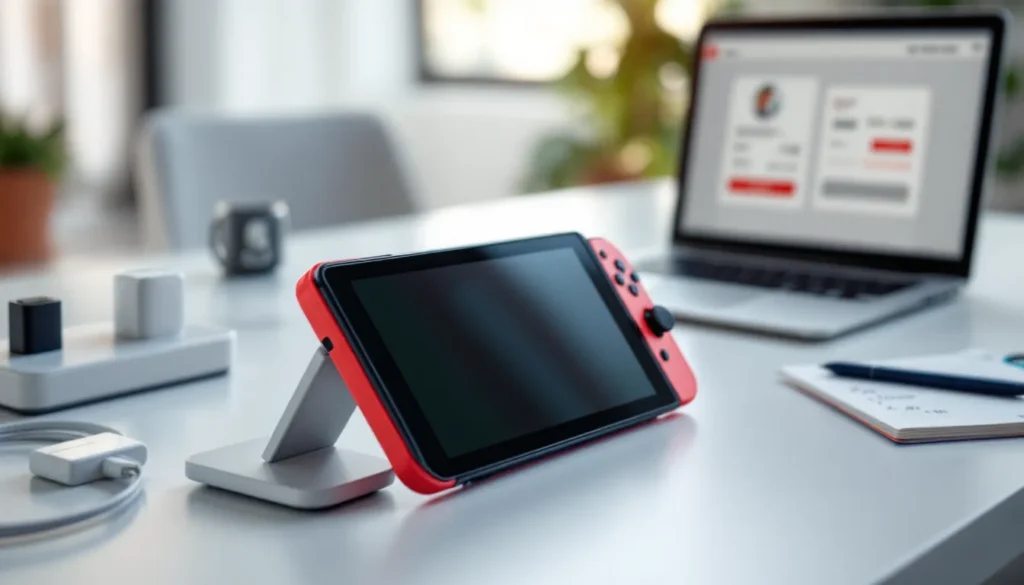
The Nintendo Switch OLED Model represents the premium tier of Nintendo’s current lineup. Inside the box, buyers get the OLED console itself, a redesigned dock with a built-in wired LAN port, two Joy-Con controllers (left and right), two Joy-Con strap accessories, a Joy-Con grip for combining both controllers, an HDMI cable, and a USB-C AC adapter.
What stands out here is the hardware refinement. The 7-inch OLED screen delivers punchier colors and deeper blacks compared to the LCD on the base model. The wider kickstand actually feels functional now, spanning the console’s back instead of that flimsy plastic tab from earlier models.
But games? Zero. Not a single cartridge, no download code, nothing pre-loaded except system software. The OLED treatment improves the experience once you’re playing, but it doesn’t solve the “what do I play first” problem.
Nintendo Switch Lite Package Contents
The Switch Lite takes a different approach entirely. This handheld-only device ships with the console unit (controllers integrated into the body), a USB-C AC adapter, and that’s it. No dock, no Joy-Con, no HDMI cable, because it doesn’t output to a TV.
The Lite launched in 2019 as Nintendo’s budget option, and in 2026 it still holds that position. It’s lighter, more compact, and built specifically for portable play. The hybrid console design that made the original Switch famous gets stripped down to pure handheld focus here.
Again, no games included. The lower price point ($199.99 MSRP as of March 2026) reflects hardware differences, not bundled software.
What You Won’t Find in the Box
Regardless of which Switch model you grab, certain items are conspicuously absent. There’s no microSD card included, even though the console’s 32GB or 64GB internal storage filling up fast with modern game installs. Digital purchases and updates eat through that space quickly.
No screen protector comes packed in either, which is a genuine oversight for a portable device. The OLED model’s screen is more scratch-resistant than older models, but it’s not invincible.
Most notably, there’s zero game software bundled with standard retail packages. Nintendo hasn’t included a pack-in title with their base Switch offerings since the console launched in 2017. That strategy differs sharply from the Wii era, when Wii Sports came bundled with nearly every console and became one of the best-selling games of all time.
The modern approach puts choice in the buyer’s hands, but it also means you’re paying extra no matter what.
Special Edition Bundles That Include Games
Current Game-Included Switch Bundles Available
Nintendo and retailers occasionally release bundles that pair a Switch console with a game, and these represent the clearest path to getting software in the box. As of March 2026, several bundles remain in active circulation.
The Mario Kart 8 Deluxe Bundle has been a consistent performer since 2021. This package includes the standard Switch console plus a download code for Mario Kart 8 Deluxe. It typically retails for around $299.99, essentially the console’s base price, making the game effectively free. Given that Mario Kart 8 Deluxe usually runs $59.99 standalone, that’s legitimate value.
Another rotating option is the Nintendo Switch Sports Bundle, which includes the game on a physical cartridge plus a leg strap accessory for certain motion-controlled activities. This bundle appeared during holiday seasons and occasionally resurfaces during major retail events.
Some retailers create their own bundles by packaging a console with a popular game and maybe an accessory or two. These aren’t official Nintendo packages but can offer competitive pricing depending on the store’s promotion calendar.
Limited Edition Console Bundles Worth Considering
Limited edition consoles tied to major game releases often include the game itself, though at a premium price. The Splatoon 3 OLED Edition launched with themed Joy-Con and dock designs, and included a physical copy of Splatoon 3. Similar treatments appeared for Tears of the Kingdom, Animal Crossing: New Horizons, and Pokémon Scarlet and Violet.
These bundles usually cost $359.99 or higher, about $60 more than a standard OLED model. You’re paying for the custom aesthetic and the game, which breaks even if you planned to buy that specific title anyway. The resale value on limited editions tends to hold better too, especially if kept in good condition.
One thing to watch: some limited editions include only a download code rather than a physical cartridge. That matters if you prefer collecting physical media or want the option to resell or trade games later.
Where to Find the Best Bundle Deals
Major retailers like Target, Best Buy, Walmart, and Amazon cycle through bundle promotions, especially around Black Friday, Cyber Monday, and back-to-school periods. These deals might add a game, extra controllers, a carrying case, or eShop credit to a console purchase.
Direct from Nintendo’s official store occasionally offers exclusive bundles or refurbished console deals that include digital game vouchers. According to Nintendo Life, checking their deals section during major sale events often surfaces bundle options not advertised elsewhere.
Membership programs matter here. Best Buy’s Gamers Club (when available), Amazon Prime, and Target Circle can stack additional discounts on already-bundled items. Some bundles might look identical across retailers, but after applying membership perks, the effective price can differ by $20-40.
Pre-Installed Games and Free Software on Nintendo Switch
The Switch doesn’t come with traditional pre-installed games, but it does ship with some built-in software that’s easy to overlook. The most significant is Nintendo eShop access, which opens the door to hundreds of free-to-play titles that don’t require any upfront purchase.
Other pre-loaded apps include Nintendo Switch Online, which isn’t free but offers a trial period for new users. There’s also the album app for screenshots and video clips, news channels for game updates, and the system settings suite. Nothing you’d call a “game” in the conventional sense, but functional software nonetheless.
Free-to-Play Games You Can Download Immediately
Once connected to Wi-Fi, new Switch owners can grab several high-quality free-to-play games within minutes. Fortnite remains one of the most popular, offering full cross-play with other platforms and regular content updates. Performance on Switch isn’t as smooth as PC or current-gen consoles, but it’s entirely playable and costs nothing.
Apex Legends hit the Switch in 2021 and continues to receive support in 2026. The battle royale genre thrives on the platform, and Apex brings fast-paced gunplay and hero abilities to handheld play. Again, expect visual and frame-rate compromises compared to PlayStation 5 or Xbox Series X, but the core experience translates.
Warframe, Rocket League, Pokémon UNITE, and Super Kirby Clash round out the free-to-play offerings worth downloading immediately. Each has optional microtransactions, but none lock essential gameplay behind paywalls. Players who want to get started with their console can build a respectable rotation without spending a dime beyond the hardware.
Nintendo Switch Online Trials and Offers
New Switch consoles often include trial codes for Nintendo Switch Online, Nintendo’s subscription service that unlocks online multiplayer, cloud saves, and a library of classic NES and SNES games. Trial lengths vary, sometimes seven days, occasionally a full month, depending on promotions active at the time of purchase.
The base NSO tier costs $3.99/month or $19.99/year as of 2026. The Expansion Pack tier, which adds N64 and Genesis games plus DLC for select titles like Mario Kart 8 Deluxe and Animal Crossing, runs $49.99/year.
Those classic game libraries provide immediate content. The NES and SNES collections include dozens of titles like Super Mario Bros. 3, The Legend of Zelda: A Link to the Past, and Metroid. Not the latest releases, obviously, but legitimate games that come with the subscription rather than sold separately.
How Much Should You Budget for Games After Purchase
First-Party Nintendo Game Pricing
Nintendo’s first-party titles maintain premium pricing longer than most publishers. Games like The Legend of Zelda: Tears of the Kingdom, Super Mario Odyssey, Mario Kart 8 Deluxe, and Splatoon 3 sit at $59.99 even years after release. Nintendo rarely discounts flagship titles by more than $10-15, and those sales happen maybe twice a year.
Budget for $60 per major Nintendo release. That pricing has held steady since the Switch launched in 2017, and shows no signs of dropping in 2026. If you’re planning to grab three or four first-party games at launch, expect to spend an additional $180-240 on top of the console cost.
Some newer releases, particularly remakes or smaller-scale titles, come in at $49.99 or $39.99. Metroid Prime Remastered launched at $39.99 in 2023, for example. But tentpole releases? Full price, almost always.
Third-Party and Indie Game Options
Third-party and indie games offer significantly more pricing flexibility. Major multiplatform releases like Hogwarts Legacy, FIFA, or NBA 2K typically match other consoles at $59.99 for current-year editions, but older entries drop to $19.99 or less within months.
Indie games dominate the Switch’s digital storefront, with prices ranging from $4.99 to $29.99. Titles like Hades, Hollow Knight, Celeste, and Stardew Valley deliver dozens of hours of gameplay for $15-25 each. According to IGN, the indie scene on Switch has become one of the platform’s defining strengths, offering depth without the budget strain of AAA releases.
A realistic starter library could include one $60 Nintendo flagship, two $20-30 indie games, and a couple of free-to-play titles. That’s about $100-120 in additional spending for a solid rotation.
Digital vs Physical Game Costs
Physical cartridges and digital downloads usually launch at identical prices, but their long-term value differs. Physical games can be resold, traded, or loaned to friends. A $60 cartridge might fetch $35-40 on the used market six months later, effectively reducing the net cost.
Digital games tie to your Nintendo account permanently. No resale value, but also no risk of losing or damaging cartridges. Digital titles take up more storage space, often requiring a microSD card ($20-60 depending on capacity).
Sales favor digital. The eShop runs promotions weekly, sometimes discounting games by 30-75%. Physical games rarely see those steep cuts outside of Black Friday or clearance situations. Players who focus on building a diverse game collection often find better deals by mixing both formats strategically.
Best First Games to Buy for Your New Nintendo Switch
Essential Single-Player Experiences
The Legend of Zelda: Breath of the Wild remains the gold standard for single-player Switch games. Even with Tears of the Kingdom now available, Breath of the Wild’s open-world exploration and emergent gameplay holds up brilliantly. Expect 50-100+ hours for a first playthrough.
Super Mario Odyssey delivers tight 3D platforming with enough accessibility for casual players and enough depth for completionists hunting down 880+ Power Moons. It’s one of the best showcases of what the Switch hardware can do.
Metroid Dread offers a modern take on 2D Metroid design, with challenging combat and satisfying progression. It’s tougher than Mario or Zelda, but rewards skilled play.
For RPG fans, Xenoblade Chronicles 3 or Fire Emblem Engage provide 60-100 hour campaigns with deep combat systems. These are time investments, but they stretch dollar-per-hour value further than most genres.
Top Multiplayer Games for Family and Friends
Mario Kart 8 Deluxe is the obvious starting point for local multiplayer. Up to four players can race on a single Switch, and the game supports all skill levels with adjustable assist features. It’s sold over 60 million copies for good reason.
Super Smash Bros. Ultimate brings competitive fighting to 74 playable characters (with all DLC). Local matches support up to eight players, though four is more practical. The skill ceiling is high, but button-mashing still produces fun chaos for newcomers.
Mario Party Superstars and Super Mario Party offer board-game-style competition with mini-games. These work best with four players and tend to create memorable (sometimes friendship-testing) moments.
Overcooked 2 and Moving Out provide co-op chaos that demands communication and coordination. Both support 2-4 players locally and test how well your group handles stress.
Must-Have Games for Competitive Gamers
Competitive players have fewer but stronger options on Switch. Super Smash Bros. Ultimate dominates the fighting game scene, with active tournament circuits and online ranked modes. The netcode improved significantly with updates, though it still lags behind dedicated fighting games on other platforms.
Splatoon 3 brings team-based shooting with a unique ink-based twist. Ranked modes and seasonal events keep the competitive community engaged. Performance sits at 60fps in most modes, crucial for competitive play.
Pokémon Scarlet/Violet support competitive battling with official VGC rulesets. The games themselves have performance issues, but the competitive battling scene remains robust.
For traditional fighters, Street Fighter 6 and Mortal Kombat 1 are available on Switch but run better on other platforms. Serious competitors typically choose PS5, Xbox, or PC versions for tournament-standard performance. According to Digital Trends, cross-platform play support varies by title, which impacts matchmaking pool size and wait times.
Ways to Get Games for Less or Free
Nintendo eShop Sales and Seasonal Discounts
The Nintendo eShop runs sales constantly. The weekly “Great Deals” section highlights 100-300 discounted games at any given time, with discounts ranging from 10% to 90% off. Major sale events hit during Black Friday, Cyber Monday, summer, and around E3/Nintendo Direct presentations.
First-party Nintendo games rarely drop below $39.99 digitally, even during sales. But third-party and indie titles see aggressive cuts. Games that launched at $29.99 might hit $4.99 during deep sales. Patience pays off here, waiting 6-12 months for a sale can save $20-40 per game.
Price-tracking tools exist for the eShop. Sites like Deku Deals monitor price history and alert users when games hit target prices. Setting alerts for wishlist titles ensures you don’t miss the brief windows when deep discounts appear.
Game Vouchers and Rewards Programs
Nintendo Switch Online members gain access to Game Vouchers, a program that offers meaningful savings on digital first-party games. For $99.98, members receive two vouchers, each redeemable for a full game from Nintendo’s eligible catalog. That’s effectively $49.99 per game, a $10 savings on titles that rarely discount.
The voucher catalog includes major releases like Zelda, Mario, Splatoon, Pokémon, and Fire Emblem. Vouchers expire 12 months after purchase, but redeemed games stay in your library permanently. For anyone planning to buy two full-price Nintendo games within a year, vouchers represent guaranteed value.
My Nintendo Rewards offers points for digital purchases and participation in Nintendo activities. Points can be redeemed for eShop discounts (typically $5-10 off select games) or exclusive digital content. The rewards aren’t game-changing, but they stack with sales for additional savings.
Physical game buyers should explore retailer rewards programs. Best Buy’s credit card offers 5% back on gaming purchases. Target Circle provides occasional 10-15% off coupons that work on video games. These discounts apply immediately rather than as future rebates.
Used Game Markets and Trade-In Options
Physical Switch games retain value better than most platforms, making the used market viable. GameStop, local game stores, Facebook Marketplace, and eBay all host active Switch game trading. Popular titles like Mario Kart 8 Deluxe or Animal Crossing might sell used for only $10-15 below retail, but older or less popular games can be found for $15-30.
Trade-in programs at GameStop, Best Buy, and Amazon accept used Switch games toward credit for new purchases. Trade-in values vary wildly, expect 30-50% of the current retail price for recent games in good condition. Games still in-demand like Tears of the Kingdom fetch higher trade-in values than older titles.
Local buy-sell-trade groups and apps like Mercari or OfferUp sometimes yield better deals than corporate trade-ins. Sellers often price games to move quickly, especially if they’re clearing out collections. Building a game library this way takes more effort but can cut costs by 40-60% compared to buying everything new.
Comparing Switch to Other Consoles: What Do They Include
PlayStation 5 and Xbox Series X/S consoles also ship without pack-in games in their standard editions. Sony occasionally bundles God of War Ragnarök or Horizon Forbidden West with PS5 purchases during promotions, and Microsoft has offered Forza Horizon 5 or other Game Pass trials with Series X bundles, but baseline packages include just the hardware.
The key difference lies in the subscription models. Xbox Game Pass Ultimate provides day-one access to all Microsoft first-party releases plus hundreds of third-party games for $16.99/month. PlayStation Plus Extra and Premium tiers offer game catalogs at similar price points. These services effectively replace the need for pack-in games by providing immediate access to large libraries.
Nintendo Switch Online’s classic game libraries don’t match the scale or recency of Game Pass or PS Plus catalogs. The $49.99/year Expansion Pack adds value, but it’s still primarily retro content rather than current-gen releases.
Steam Deck, a direct competitor in the handheld space, doesn’t include games but grants access to users’ existing Steam libraries. Anyone with a PC gaming history immediately has hundreds of compatible titles without additional purchases. That’s a massive advantage for PC gamers, but irrelevant for those new to the ecosystem.
When evaluating which console offers the best value, the initial software situation matters less than the long-term cost of building a library. Switch games hold their price longer, but also retain resale value better. PlayStation and Xbox games drop in price faster but lack resale potential if purchased digitally. The math depends heavily on buying habits and platform preferences.
Conclusion
Standard Nintendo Switch packages don’t include games, but that’s not the deal-breaker it might seem. Special bundles, free-to-play titles, subscription trials, and strategic shopping can soften the blow. The real question isn’t whether the Switch comes with games, it’s how to build a library efficiently without dropping $300 on software in week one.
Focus on bundles during major retail events. Grab a couple of free-to-play games immediately. Take advantage of Nintendo Switch Online trials to access classic libraries. Mix first-party flagships with budget-friendly indie gems. The Switch’s strength has always been its game library, not what ships in the box.
Buyers who plan ahead and shop smart can walk away with a console and 5-10 quality games for $400-450 total. That’s not pocket change, but it’s manageable. And once that foundation is set, the Switch delivers hundreds of hours of gameplay across genres and playstyles that still aren’t replicated anywhere else in 2026.